 Soft 17
Blackjack Basic Strategy Chart (6 Decks, S17) — Printable
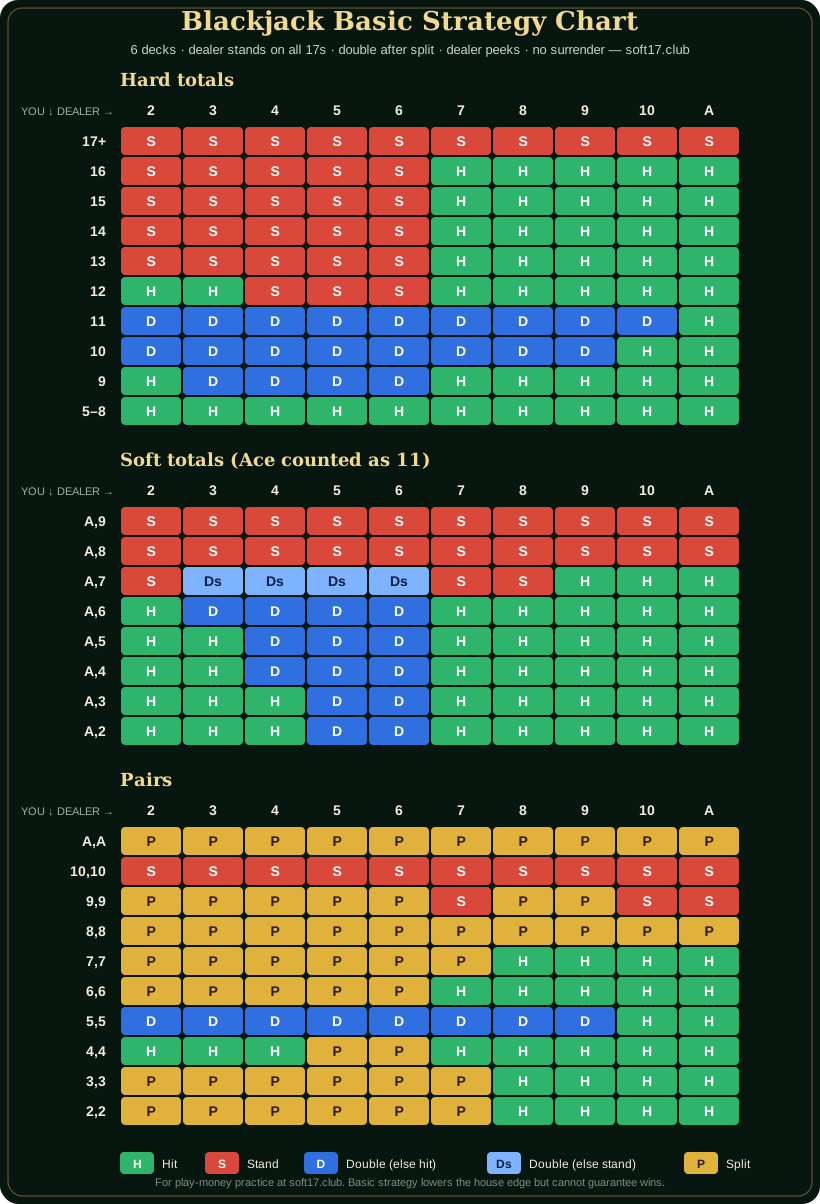
Basic strategy is the mathematically best way to play every hand of blackjack when all you can see is your own cards and the dealer's up card. The chart below is for the rules used at Soft 17: six decks, dealer stands on all 17s, double after split allowed, dealer peeks for blackjack, no surrender. Find your hand in the left column, find the dealer's up card across the top, and read the play.
| You ↓ Dealer → | 2 | 3 | 4 | 5 | 6 | 7 | 8 | 9 | 10 | A |
|---|---|---|---|---|---|---|---|---|---|---|
| 17+ | S | S | S | S | S | S | S | S | S | S |
| 16 | S | S | S | S | S | H | H | H | H | H |
| 15 | S | S | S | S | S | H | H | H | H | H |
| 14 | S | S | S | S | S | H | H | H | H | H |
| 13 | S | S | S | S | S | H | H | H | H | H |
| 12 | H | H | S | S | S | H | H | H | H | H |
| 11 | D | D | D | D | D | D | D | D | D | H |
| 10 | D | D | D | D | D | D | D | D | H | H |
| 9 | H | D | D | D | D | H | H | H | H | H |
| 5–8 | H | H | H | H | H | H | H | H | H | H |
| You ↓ Dealer → | 2 | 3 | 4 | 5 | 6 | 7 | 8 | 9 | 10 | A |
|---|---|---|---|---|---|---|---|---|---|---|
| A,9 | S | S | S | S | S | S | S | S | S | S |
| A,8 | S | S | S | S | S | S | S | S | S | S |
| A,7 | S | Ds | Ds | Ds | Ds | S | S | H | H | H |
| A,6 | H | D | D | D | D | H | H | H | H | H |
| A,5 | H | H | D | D | D | H | H | H | H | H |
| A,4 | H | H | D | D | D | H | H | H | H | H |
| A,3 | H | H | H | D | D | H | H | H | H | H |
| A,2 | H | H | H | D | D | H | H | H | H | H |
| You ↓ Dealer → | 2 | 3 | 4 | 5 | 6 | 7 | 8 | 9 | 10 | A |
|---|---|---|---|---|---|---|---|---|---|---|
| A,A | P | P | P | P | P | P | P | P | P | P |
| 10,10 | S | S | S | S | S | S | S | S | S | S |
| 9,9 | P | P | P | P | P | S | P | P | S | S |
| 8,8 | P | P | P | P | P | P | P | P | P | P |
| 7,7 | P | P | P | P | P | P | H | H | H | H |
| 6,6 | P | P | P | P | P | H | H | H | H | H |
| 5,5 | D | D | D | D | D | D | D | D | H | H |
| 4,4 | H | H | H | P | P | H | H | H | H | H |
| 3,3 | P | P | P | P | P | P | H | H | H | H |
| 2,2 | P | P | P | P | P | P | H | H | H | H |
How to read the chart
- Work out your hand. A pair (two cards of the same value) uses the Pairs table. A hand with an Ace counted as 11 is soft. Everything else is hard.
- Look at the dealer's up card across the top. A 10, Jack, Queen or King all count as 10.
- Follow the letter. Double means double your bet and take one card. If you cannot double (for example you already have three cards), use the fallback: hit for "D", stand for "Ds".
The rules behind these plays
A basic strategy chart is only correct for a particular set of rules. This one assumes:
- Six decks, with the dealer standing on all 17s (see the soft 17 rule).
- You may double on any first two cards, including after splitting.
- The dealer checks for blackjack when showing an Ace or ten, so a dealer blackjack ends the hand at once.
- Blackjack pays 3 to 2. There is no surrender.
Followed perfectly, these rules leave the house with an edge of well under one percent, somewhere around 0.4 to 0.5 percent, which is among the smallest in any casino game. That is an average over a very large number of hands; any single session can go either way.
Easy rules of thumb
- Always split Aces and 8s. Never split 10s, and treat a pair of 5s as a hard 10.
- Always stand on hard 17 or more.
- The dealer's weakest cards are 4, 5 and 6. Against those you take fewer risks, for example standing on a hard 12 to 16 instead of hitting.
- Double when the dealer is weak and your total is 9, 10 or 11.
- Against a dealer 7 or higher, a hard 12 to 16 has to hit, because a dealer showing a strong card is likely to finish with a strong hand.
- Basic strategy does not use insurance. In the long run it is a losing side bet for players who are not counting cards. Read more about insurance.
If the table rules are different
- Dealer hits soft 17 (H17): double 11 against an Ace, double Ace-8 against a 6, and double Ace-7 against a 2.
- No double after split: split 2s and 3s only against a 4 to 7, never split 4s, and split 6s only against a 3 to 6.
- Late surrender offered: surrender a hard 16 against a 9, 10 or Ace, and a hard 15 against a 10.
- Blackjack pays 6 to 5: the chart plays the same, but the game is worse for you. See blackjack rules compared.
Practise for free
The quickest way to learn the chart is to play with it beside you. Soft 17 is free, needs no sign-up, and uses play-money chips. The computer players at the house tables mostly follow this chart, with the odd human-looking slip, so you can watch them play too.
Play responsibly
Soft 17 is a game with no cash value. If you play blackjack for real money elsewhere, only stake what you can afford to lose, set limits before you start, and remember that no strategy guarantees a win. Free, confidential help is available in the UK from BeGambleAware.
Frequently asked questions
What is basic strategy in blackjack?
Basic strategy is the mathematically best play for every combination of your hand and the dealer's up card for a given set of rules. It reduces the house edge to well under one percent but cannot guarantee a win.
Is there one basic strategy chart for every game?
No. The correct plays depend on the rules. This chart is for six decks, dealer standing on all 17s, double after split and no surrender. Other rule sets change a few plays.
What does Ds mean on a strategy chart?
Ds means double if you can, otherwise stand. It applies to a soft 18 (Ace and 7) against a dealer 3 to 6.
Should I always follow basic strategy?
If you want the lowest house edge, yes. Basic strategy is the best way to play without counting cards, but any one session can still win or lose.
Does basic strategy include taking insurance?
No. For players who are not counting cards, insurance is a losing side bet in the long run, so basic strategy declines it.
What do I do with a hard 12 against a dealer 2 or 3?
Hit. You stand on a hard 12 only against a dealer 4, 5 or 6.
Play free blackjack with friends